Thursday, May 24, 2012

Sears, Northwest Plaza

I have a sentimental soft spot for the Northwest Plaza Sears, as its architecture is very similar to the mall I went to as a child in Saginaw, Michigan, Fashion Square Mall.
I also realized that in some ways the architecture reminds me of Jabba the Hutt's palace from third Star Wars movie.
Perhaps a serious problem for Northwest Plaza was that while the interior received a face-lift, the outside did not.
Yes, that is a hawk sitting on the roof of the canopy in front of the store.
Lava rock abounds in this building, and it adds a nice touch to the decoration.

Wednesday, May 23, 2012

Fixture Storage, Lemp Brewery

The fixture storage building at the Lemp Brewery is functional, but sparse. I was particularly drawn to the massive steel columns which hold up the floors.

Tuesday, May 22, 2012

Lemp Brewery, Revisited

I never get tired of the Lemp Brewery, and every time I look at it, I see a new angle. These photos were mainly taken while walk south down DeMenil Place.


Monday, May 21, 2012

Wells-Goodfellow #3: The House of Horrors

As I’m sure many of you had, I read the reports last week of the atrocious torture and killing of six dogs in an abandoned apartment building in the Hamilton Heights neighborhood of St. Louis. While I consider the building in question, at 5321 Wells Avenue, to be in Wells-Goodfellow, nonetheless it is in one of the most deeply troubled areas of the city.
While not the smartest action to take, I felt a personal need to go see this neighborhood, and perhaps get some sort of grasp of how this happens. I set out for the street, and reached it from South City in about fifteen minutes. I was expecting a bombed out neighborhood, with only a few houses scattered here and there surrounded by dense undergrowth, as I had seen in other part of Wells-Goodfellow. Much to my surprise (though certainly predicted by Google Maps), the streets around the apartments in question are still densely populated, with few empty lots and only a few abandoned houses. How did the sound of six dogs being tortured to death go unnoticed? It seems to be an impossibility.
I turned down Arlington Avenue from MLK Dr. and saw dozens of people out in the street, and I got the distinct feeling I was being watched. When I reached the corner of Arlington and Wells, I realized that it was not a good idea to proceed down the street. Out in front of a corner store were a group of young men, all dressed identically in red polo shirts, loitering. They saw me and started yelling unintelligibly. If you look back at the pictures Stray Rescue posted, you can see the gang graffiti features a reference to the Bloods street gang. Did those young men perhaps know who had committed the unspeakable acts in the apartments a block away down Wells Avenue?
I wasn’t waiting around to find out, and proceeded another block down Arlington, turned down the next street parallel to Wells Avenue and then turned out onto Union Avenue and headed back downtown. I snapped some furtive photographs from my car, which give you an impression of what the area looks like.
My investigation raises some questions in my mind. Clearly people on Wells Avenue knew exactly what was going on in that house of horrors, where six dogs were mutilated and tortured over the course of several weeks, based on the state of decomposition of several of the dogs. The drug dealing had been going on there for a while as well. Were they too terrified or too apathetic to contact the police? Considering how blatantly those gang members were showing themselves out in broad daylight with little fear of harassment by the police, I suspect the former. In fact, I have never seen such obvious gang presence in the city of St. Louis, anywhere.

Also, why the heck does the woman who owns this building even own it? She's not doing anything with it, and just letting it sit and rot and become a haven for crime. The city will never, ever recover until it gets serious about absentee slumlords, allowing their "investment properties" to be maintained like this. She should answer for her negligence as well, since she is legally responsible for what happens on her property. "I'm trying my best," a common refrain of slumlords when confronted by news cameras, is not good enough.
It also begs the question, how did this obviously once nice neighborhood fall so far? If you look at Google Maps, you can see the huge yards and stately homes that propagate in this area. Judging from the housing stock, I would suspect it was middle to upper middle class, correlating with what I have read about Wells-Goodfellow in books about the city. The apartment building where the crimes occurred is actually a beautiful building, and probably once commanded high rents. Its huge backyard once probably hosted innumerable barbeques and pick-up baseball games, but one hundred years later, it hosts nothing but horrors.
Update: A man has been charged in the crimes, according to media reports.

Sunday, May 20, 2012

"Obsolete" and "Blighted" Neighborhoods

This was the plan that basically condemned a large portions of the buildings inside Grand as "obsolete." While it might be trivial, much of what was labeled thus was in fact torn down. "Blighted" areas are now some of the most prized, and in some cases, the most troubled areas of the city today. Thank God they didn't get their way completely.

Saturday, May 19, 2012

Friday, May 18, 2012

Stacy Park/Reservoir

Few people passing by on Olive Street Road in Creve Coeur realize they're passing a 100 million gallon reservoir for the City of St. Louis.
Built in conjunction with the Howard Bend Treatment Plant in the early 20th Century, the reservoir received water pumped uphill from the plant, and then gravity took the water downhill to the city.
There are a couple of interesting buildings around the site, and interestingly, I did not see a single sign stating the purpose of the structure. If you look at Google maps, you can see there is a right-of-way going east from the reservoir that is probably the path of the water pipe.

Thursday, May 17, 2012

Howard Bend Water Plant

Most people don't know it, but much of the water for the City of St. Louis (and some sold to St. Louis and St. Charles counties) comes in via the Howard Bend Water Treatment Plant on the Missouri River, fifteen miles from the city limits.

It is a massive, complex, with its towering smokestack, and it possesses a incongruous presence among the lowlands and farm fields around it.


Wednesday, May 16, 2012

Five Year Anniversary Post: A Manichaean Choice? Preservation vs. Development

Five years ago today, when I started this website, I never imagined that I would be posting close to every day. In the first year, I posted anywhere from two to three times a week, at most. Somewhere along the line, though, I posted seven times in one week, and I've never stopped. Looking back, it's interesting to see places I've photographed repeatedly for five years, and places I've just started photographing this year. Sadly, the first building I photographed that was threatened with demolition was the Switzer Building on Laclede's Landing; five years later, the site still sits vacant, not even properly graded and planted with grass.

Why do I continue? Maybe it really is an addiction, but it's a very rewarding one. I love every comment you all send me, thanking me for exposing you to some new (old) building in some corner of the city. It's ironic, because for every "undiscovered" part of the city, there are hundreds of people living around it that have already known about it for years. I like to think though, that my work, and the work of my colleagues, is changing people's opinions of the city. If just one person moves to the city, buys a house and fixes it up before it gets demolished for "progress" then I feel I have accomplished something. If I can get at least a couple people to get over the odious pessimism that so often engulfs this city, then I consider my work meaningful.

I'm so proud of my friends for successfully rallying and saving the old Del Taco building on Grand; slated for demolition for being "undevelopable," it is now going to be developed into host two restaurants, perfect for the large student population around St. Louis University. Funny how a building can go from one to the other in the span of a couple of weeks, isn't it? Maybe it just has to do with your attitude?

Which brings me to the message I have for all of you on the fifth anniversary of this site.

This spring hasn't been good for historic preservation in St. Louis.

Buildings get demolished every year in St. Louis, but the loss of two icons of the region's architectural heritage are meeting (or have met) the wrecking ball as I write this. I understand that not every building will be saved in this war for protecting the built environment in St. Louis, but what truly disturbs me is the attitudes of the people condoning their demolition and their sarcastic dismissal of preservation. While there are certainly preservationists out there that support saving buildings at all cost, even it means they sit empty for a century, most people I know who support historic preservation do so out of practical reasons. It simply is more logical to reuse an existing, great-looking building than waste the energy to tear it down and replace it with something that will probably not last nearly as long as the original. The walls of my house are one foot thick; short of an earthquake or roof failure, do you think anything would make them budge? Compare that to nowadays, where the floors of new houses I visit in the suburbs shake when I walk across them (I weigh 160 lbs). The floors don't shake in my house when I walk across them. Coincidence? I think not...

Numerous politicians and unelected leaders, who shall go unnamed, believe that the preservation of historic architecture, is an either/or Manichaean choice; you can either have development, or you can have old buildings. The simplicity, the shear stupidity and arrogance of this belief is killing St. Louis. Can you name one major historic building demolished since World War II in St. Louis that has given the city a huge boost in either tax revenue or economic activity? I challenge anyone to explain why tearing down the Ambassador Theater, Real Estate Row or any of the thousands of anonymous houses around the city that were structurally sound has benefited the city. Do you realize that all of the neighborhoods now featured in tourism brochures for St. Louis were once seriously threatened with complete or partial demolition? Yes, someone once thought it would be a good idea to clear cut Soulard, Lafayette Square, most of downtown and pretty much every house inside Grand Boulevard at one time or another. Stand up to those who say economic activity is impossible without demolition, and I suggest that if pro-demolition zealots are so principled, they should recuse themselves from enjoying all of those great, revitalized neighborhoods mentioned above which were saved from the wrecking ball--from their type of people.
In closing I want to share two pictures submitted to me by reader Keith Raske of a bizarre sight on Lafayette Avenue and Nebraska, an area heavily decimated by "good ideas." Yes, it is a double-wide trailer set up on three vacant lots, right next to two handsome Italianate rowhouses. Who wants to place a bet on whether the double-wide or the rowhouses will still be standing in fifty years?

Is that what you want your city to become?

Tuesday, May 15, 2012

St. Louis Centre, Eviscerated

Alerted by posts at Vanishing St. Louis and the Preservation Research Office, I decided to use the new St. Louis Centre Memorial Parking Garage last Friday. That was a big mistake.
I had already seen the new exterior, but I wanted the opportunity to see the new parking garage built in the floors of the old mall. I must say, it is the most open, light-filled parking garage I have ever parked my car in, but when I tried to exit by a staircase, I was greeted by signs saying that the exit was for emergencies only. I had to go back up the stairs, checked to verify that there was in fact no sign saying that I couldn't use that staircase, and eventually just took an elevator down to 7th Street. What a bizarre place.

Monday, May 14, 2012

Castle Ballroom

The Castle Ballroom, nominated for the National Register of Historic Places, is a little rough around the edges right now, but is still a stable and important building.
One of the few buildings left from the historic Mill Creek neighborhood, the ballroom provided entertainment for around fifty years.
While it's described as Renaissance Revival in the nomination, I would have to disagree; it is more of a severe example of classical revival architecture, though I see one element, the curved lintel over the first floor door is inspired by the architecture of Michelangelo.
Originally red brick, it was painted the garish yellow sometime later. Though in St. Louis, with its wide variety of colored bricks, it is sometimes hard to tell.

Sunday, May 13, 2012

My Arm, Wildwood

My arm, accidentally photographed somewhere around Glencoe, Missouri.

Saturday, May 12, 2012

One of The Last Farms in Chesterfield

Will this farm be turned into a subdivision one day? I hope not since it sits right on Clarkson Road, reminding everyone how much better the county could have turned out.

Friday, May 11, 2012

Orrville, Wildwood

Orrville, a small town buried deep back in the wooded hills of northeastern Wildwood, sits just off of old Eatherton Road.
The country store building survives, but is now a private residence.
This is the only town where I was able to photograph all of the buildings in town.

Thursday, May 10, 2012

Rock Hill Presbyterian, Totally Gone

I drove over to Rock Hill Presbyterian last Thursday, expecting to see some jagged walls sticking out of the ground, slightly more dismantled than I had seen it the Saturday before. Instead, I saw nothing. The church was completely gone, and I gasped when it dawned on me what had happened. According to the Post-Dispatch, they took it down "carefully" in three hours, numbering stones as they went. I seriously doubt that. What a joke.
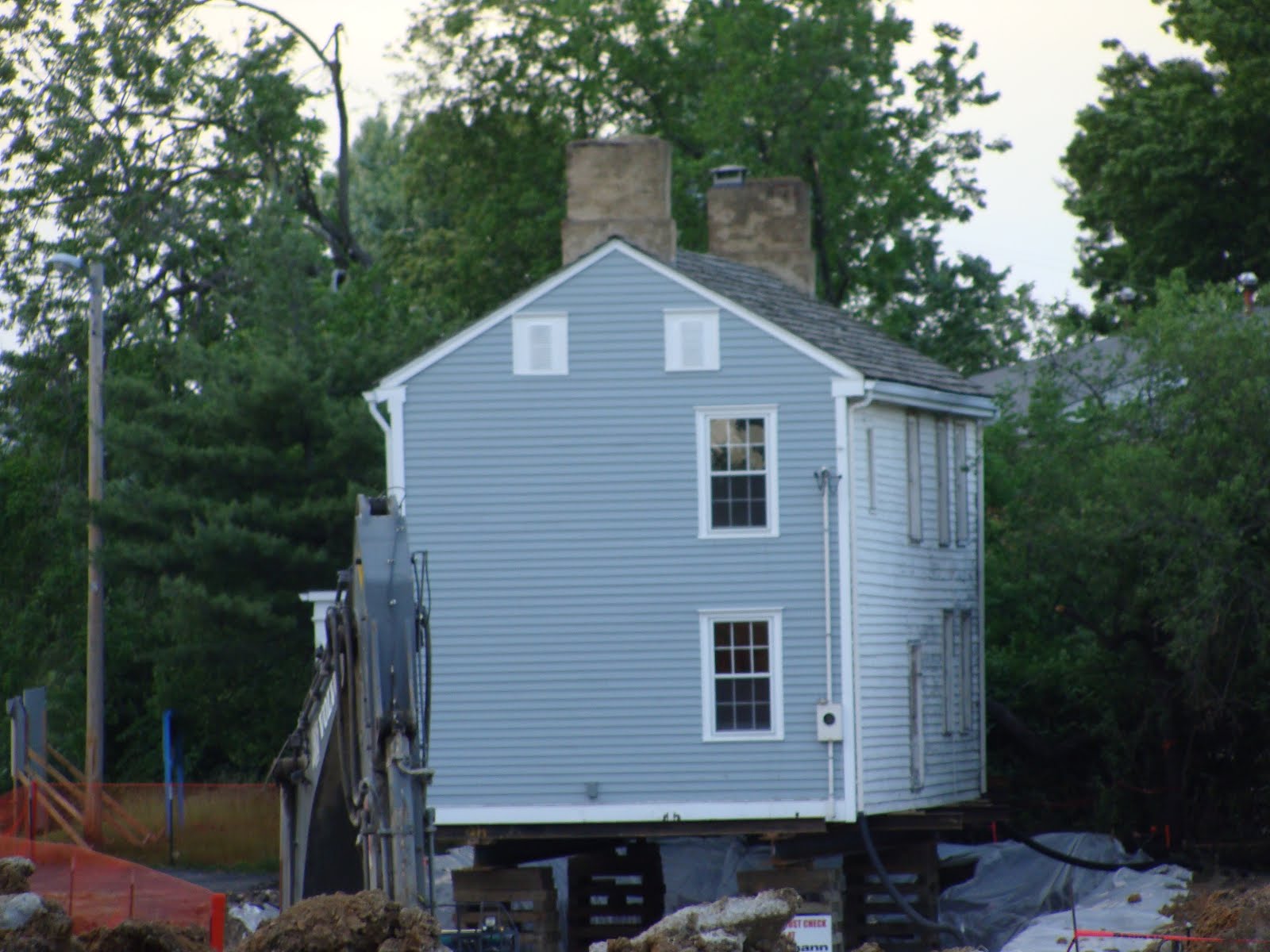
Fairfax House, bizarrely floating on steel stilts, had been moved to its corner of purgatory on the north end of the site, ridiculously close to the road and completely devoid of context. I feel bad for all of the people who have worked so hard restoring it to its past appearance.

Anyways, it's been long established that the leadership of Rock Hill are a bunch of revenue addicts, willing to do anything--even sell their grandmother's wedding ring, or historic church--for their next fix. I predict here now that at least one, possibly two, of the currently operating gas stations in Rock Hill will go out of business in the six months after the UGas opens. It will be interesting, and depressing, to see if the fiefdom even comes out of this with more tax revenue than before they sold their community's soul.

But what's truly pathetic is the decision of the Giddings-Lovejoy Presbytery to sell such an historic church to UGas, fully aware that it would mean its demise. Sure, it was the smart business decision, but certainly not the smart moral decision. While I'm sure the Presbytery had full legal title to the church, I would argue that they did not hold the spiritual title to it. It belongs to the slaves, immigrants and the generations of members who first built and then attended services for almost 170 years. Was their hard work and devotion so meaningless?

A Blog detailing the beauty of St. Louis architecture and the buildup of residue-or character-that accumulates over the course of time.