Showing posts with label West County. Show all posts

Thursday, May 17, 2012

Howard Bend Water Plant

Most people don't know it, but much of the water for the City of St. Louis (and some sold to St. Louis and St. Charles counties) comes in via the Howard Bend Water Treatment Plant on the Missouri River, fifteen miles from the city limits.

It is a massive, complex, with its towering smokestack, and it possesses a incongruous presence among the lowlands and farm fields around it.


Saturday, May 12, 2012

One of The Last Farms in Chesterfield

Will this farm be turned into a subdivision one day? I hope not since it sits right on Clarkson Road, reminding everyone how much better the county could have turned out.

Friday, May 11, 2012

Orrville, Wildwood

Orrville, a small town buried deep back in the wooded hills of northeastern Wildwood, sits just off of old Eatherton Road.
The country store building survives, but is now a private residence.
This is the only town where I was able to photograph all of the buildings in town.

Saturday, May 5, 2012

Italianate Farmhouse, Wildwood

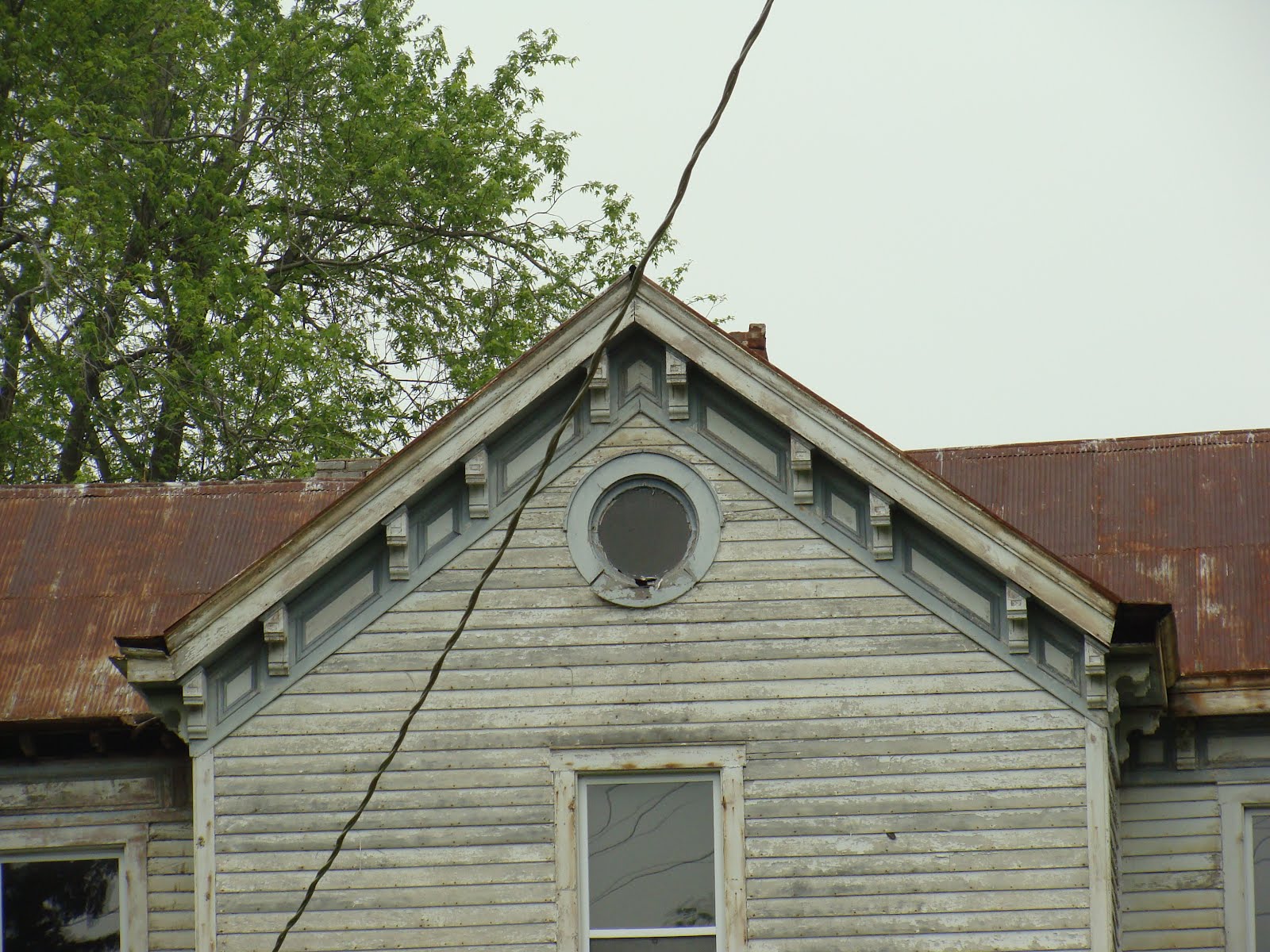
Just east of Pond is this rustic, but beautiful Italianate farmhouse. The paint is faded, but the intricate details remain. Will someone save it before it is demolished? I hope so.

Friday, May 4, 2012

Big Chief Roadhouse, Pond, Wildwood

Pond was long a good place to stop for travelers heading west from St. Louis. While the earlier Pond Hotel served the travelers of the 19th Century, the Big Chief Hotel provided more elaborate lodgings for the new automobile travelers passing through the area.
Spanish Colonial Revival in style, which is obviously not native to Missouri, the hotel predicted the oftentimes unique and eccentric hotels lining the original Route 66.

Thursday, May 3, 2012

Pond, Wildwood

Further down Manchester Road to the west, Pond actually has houses that are much older than its neighbor Grover.
In particular, this double house right at the corner is a great example. It's a cool house, in bad shape, and is currently sitting vacant. What is the story behind this house?
There also is a gas station from what looks like the 1920's, which is now some sort of business.
The old house on the corner was a French restaurant a few years ago, but now it sits empty. It's an interesting house, but like the rest of Pond, is made of wood and lack of maintenance is taking its toll.
The general store, now closed, is actually built in front of an older house, perhaps as an expansion of the original, smaller house.
Updated: Thanks to Lynn Josse, I have learned more about the long, dilapidated building pictured above; it was the Pond Hotel, and you can read about its plight here.


Wednesday, May 2, 2012

Grover, Wildwood

Grover is a small hamlet out old Route 66--the first route--more commonly known as Manchester Road.
There are still a fair number of houses left, including these two very old and rustic cottages, as well as a couple of businesses.
Thankfully, when Highway 100 was rerouted, it spared the town and its nearby western neighbor of Pond.
Time has passed by this town, though there are plans for more development in the town.

Tuesday, May 1, 2012

Glencoe, Wildwood

Down the narrow, tree lined roads of Wildwood, in far western St. Louis County, are numerous small unincorporated towns, now part of the largest city by square mileage in the region.
Glencoe was one such small town, focused on the mining and lime industries now contained within Rockwood Reservation along the Meramec River. At one time it was a bustling town, with a school, general store and church.
Floods in the late 1990's wiped out much of the town near the river, but many houses still survive further up the hill.
Like many of the small towns in this part of the county, Glencoe once had a much larger population, but as the railroad ended its stops in the town, it shrank into the small hamlet that it is today.
Read about the town here.

Friday, April 6, 2012

Modernist House, Town and Country

I recently had the opportunity to document a unique--and very long--modernist house out west in Town and Country. The developer/real estate agent kindly offered me the chance to document the house before it was demolished for a new house.
The house sits on a large lot, and has a beautiful pond in front of the house. Records show the house was first built in 1949, and then a large expansion and renovation pushed the house to close to 200 feet long, almost the entire width of the property.
The natural setting kept pulling my eyes away from the actual house, which is interesting in its own right.
The origins and architect of the house remain a mystery, but the original portion of the house captures beautiful views out to the flowering magnolias and other landscaping features.
While comparisons to the more famous Morton D. May house could be made, I don't feel it's the best comparison. While the May house had large amounts of original fabric, I'm afraid upon my inspection that this house was stripped of any interesting Modernist fixtures or accents in the 1980's renovation.
What was left was largely a very giant house, stretching a long way and with a lot of oddly shaped rooms lacking Modernist context.
The back of the house was not looking too hot, and betrayed its age. The living room, seen below, was really the centerpiece of the interior of the house.
I can imagine how originally this room followed Frank Lloyd Wright's desire for the interior and exterior to flow seamlessly between the two realms.
But unfortunately, like all flat roofed houses (and particularly seeming to strike Modernist houses), the only thing flowing the day I was there was an obviously large pool of standing water on the roof, as evidenced by the reflected ripples on the wall above the ceiling. Stripped of its original fabric, this Modernist house is an interesting footnote in St. Louis architectural history.
Philip Vincent, who generously allowed me to photograph the house before it was demolished, asked me to post this:

I'd like to give you a couple facts about the house. Built in 1949, 6000 square feet, 180 feet wide. The old house prevented people from understanding the true size of the 2.6 acres.

After a year of showing it to rehabbers and Modern "fans" we have decided to bring the old house down to make way for a new home in the 1.5 to 2 million range. The new home will also be 6000 square feet (but not 180 feet wide!) The realtor is Phillip Vincent 314-537-7445 with the Hermann London Group. My website is http://www.hermannlondon.com/phillip-vincent

Tuesday, February 14, 2012

Centaur, Revisited

I made it back out to the hamlet of Centaur, which is now being swallowed up by suburban development. It's slow, I should say, as this McMansion has been under construction now for years, and seems abandoned. I finally figured out where the quarry is; it is now fenced in as private property, but you can clearly see the hole in the cliff.
The old town store and post office sits in much the same state as I saw it two years ago.
The school house has been restored, and now looks great. I find this little town infinitely fascinating; the standard narrative of the history of St. Louis County is one of growth, but it bears mentioning that some parts have actually seen their population decline greatly, from a previous life as a quarry town or rural stopover deep in the wilderness.

Sunday, February 5, 2012

The Danger Zone, Highway 40 at I-270

While sitting in stopped traffic just west of 270, I looked out my window and saw the detritus of an earlier crash. What a mess that interchange is; people die around there all the time because of its dangerous conditions, but most people don't think twice about still frequenting the area.

Saturday, February 4, 2012

Old Slave Road, Revisited

I drove back by Old Slave Road, and was surprised to see that the road is now signed with its historic name, as well as its modern name, Spiceberry Lane.

Friday, June 24, 2011

Valley Park Elevator

The historic Valley Park Elevator is the only remaining elevator in St. Louis County, and it even has its own website nowadays.

Thursday, June 23, 2011

Meramec Valley Bank

I thought this bank building in Valley Park deserved mentioning, with its sleek lines and rock wall contrasts.

A Blog detailing the beauty of St. Louis architecture and the buildup of residue-or character-that accumulates over the course of time.