Showing posts with label Benton Park. Show all posts

Wednesday, May 23, 2012

Fixture Storage, Lemp Brewery

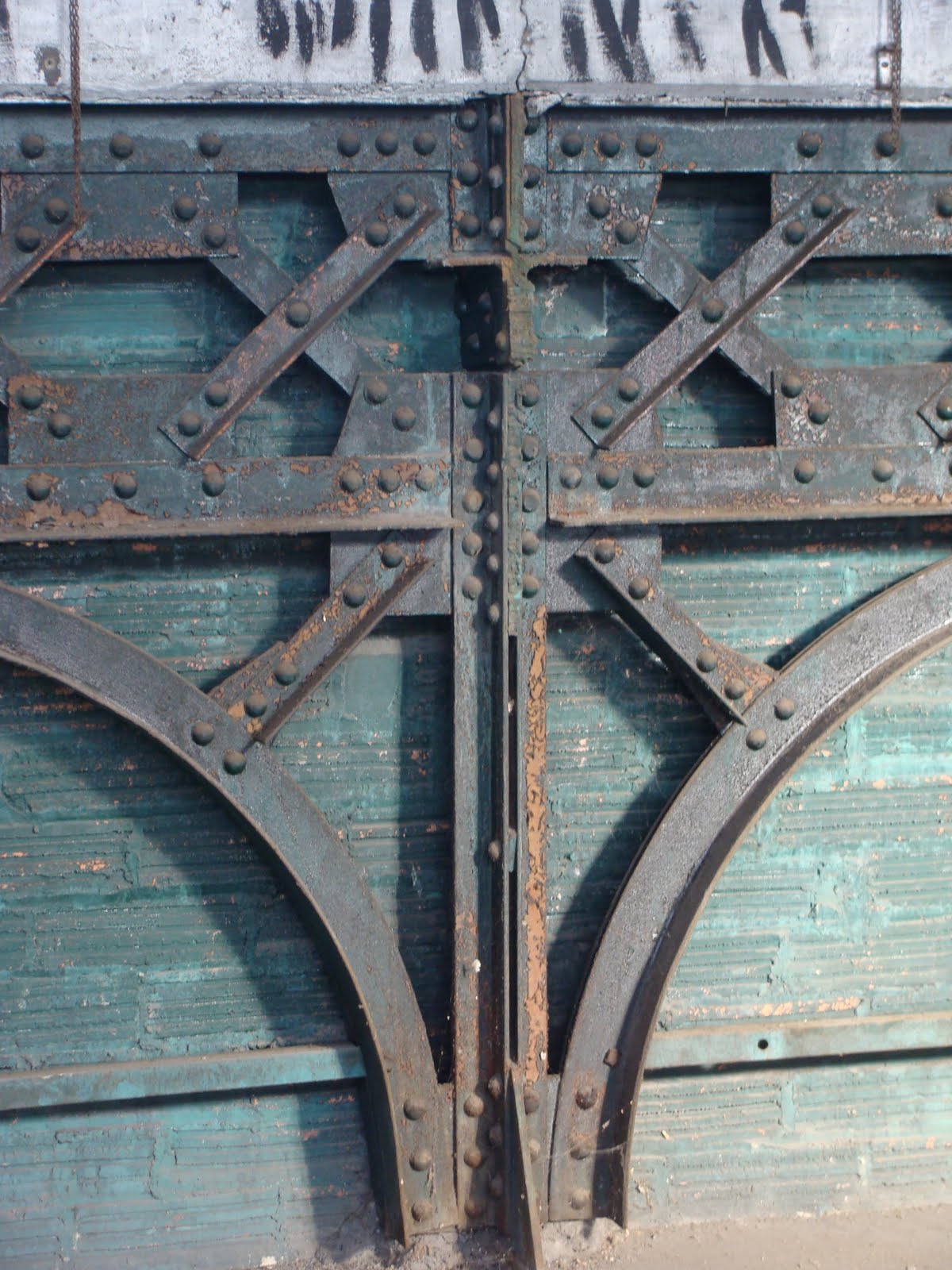
The fixture storage building at the Lemp Brewery is functional, but sparse. I was particularly drawn to the massive steel columns which hold up the floors.

Tuesday, May 22, 2012

Lemp Brewery, Revisited

I never get tired of the Lemp Brewery, and every time I look at it, I see a new angle. These photos were mainly taken while walk south down DeMenil Place.


Friday, April 13, 2012

Falstaff Brewery Plant Ten, Former Consumers/Griesedieck Brewery

Falstaff Brewery Plant Ten is a strange place, in that it has had numerous owners and brewers over the years. It's actually sort of hard to tell how many it's had. Also, I think many of the buildings around the brewhouse, once part of the brewery operation, are under different ownership than the main building.
A wonderful remnant of the plant's ownership by the Griesedieck Brewery is left on the wall of the side of the brewery building, though slightly faded.
Likewise, caves still exist under the building and Lemp Avenue, and if you put your hand over the grates, the cold air of the cave can be felt. It is definitely not a sewer; I tested it myself on a hot day and frigid air met my hand.
Across Lemp Avenue, there is an auxiliary group of buildings that looks like it was built in the 1950's or early 60's.
Please visit this great Falstaff Beer site, where I learned most of my information about the old brewing company. Also, I want to thank Andrew Weil, director of the Landmarks Association of St. Louis, for additional information.

Thursday, March 15, 2012

Benton Park

The setting of Benton Park is one of the most beautiful in the city, with intact streets surrounding it on all sides except for Jefferson on the west.
Set as a typical Victorian park, with long winding trails that snake around the park, it was designed for strolls, and not as a formal space.
Interestingly, I just learned the massive and well-preserved English Cave complex is still hidden deep under much of the park.
Preserved because the park never massive development, it was sealed in the Twentieth Century, but there may still be entrances in some of the houses in the area.
As can be seen from the high point in the park, which commands stunning views over the area, the nearby Lemp Brewery took advantage of its own branch of caves under South City.
Oh, and there's this obelisk, dedicated to some German guy. It sits resplendently alone, on top of the ridge of a hill on the south side of the park.

Sunday, November 27, 2011

Jefferson Avenue, South St. Louis

One of these days I'm actually going to get out of my car and walk the full length of Jefferson from I-44 to Broadway, and document what a wonderful street it is architecturally.

Tuesday, August 16, 2011

Lemp Brewery, Corner of Cherokee and Lemp Streets

Labeled as the "Liquid Carbonic Co." on early Sanborn Fire Insurance maps, the building served various functions, looking at the list of labels on the map. Carbonic acid would have presumably been added to the beer to increase its carbonation.I still can never get enough of the towering grain silos that sit right on Lemp Avenue; simple and clean lines create the perfect utilitarian industrial structure in St. Louis.I would love to look up one of the silos; I assume they are sitting empty.

Wednesday, December 8, 2010

Top Floor, Lemp Brewery

The top floor of the power plant is a stunning space, one that no longer exists in present-day industrial construction, as a reader of this site noted last week.I am strongly suspecting the power plant was built after the brewery closed; carefully looking for sign scars on the smokestack, I can only find the International Shoe Company logo. Surely the Lemps would have put their name on the smokestack first?I love the steel trusses in this room, and how they were left exposed to show the structure of the building.I have no idea what this room was used for, or how it functioned in the use of the brewery as a warehouse for shoes. Supposedly, shoes were also manufactured here as well, but I don't have a reliable source to confirm that.
Tuesday, December 7, 2010

Power Plant, Lemp Brewery

It's a little confusing to know exactly where I was in the brewery when I went in the building along Broadway with the smokestack. It does not appear on the Insurance Map, so I am wondering if it was a more recent addition. A ramp connects the two buildings that are along Broadway; one building is clearly older and has a railroad access tunnel through it.The interior is a massive space, with huge open floor plans that allow for any number of uses, including art exhibits.I would like to know more about these two buildings that sit right next to each other, but am not sure how to proceed.See it from the air here. I suspect the building on the right may have been built by the International Shoe Company when it bought the complex during Prohibition.

Monday, December 6, 2010

Malt and Stock Houses, Lemp Brewery

I know very little about brewing, but buildings labeled "malt house" and "stock house" are almost certainly involved in the direct brewing of beer.If you look closely, you can see where the tanks used for brewing the beer were located.The buildings themselves are massive, amazingly proportioned and still have some nice decorative detail.Imagine product gliding across the rollers or conveyor belt in between buildings.I love the door to the Fermenting Department; it looks like the door to a temple, a temple of beer brewing or something.Street trackage, now embedded deep within the brewery is always fascinating to me; the idea that trains once went down the middle of streets in major cities blows me away.The rest of the photos are from in between the two massive buildings, showing what is actually a fairly intimate space. I can only imagine the hustle and bustle of what was at the time the busiest brewery in the world.


A Blog detailing the beauty of St. Louis architecture and the buildup of residue-or character-that accumulates over the course of time.