For some reason, when they tore down the rest of the Wendy's, they left the sign. On the other side it says "CLSED."
Also, I will be presenting about the exciting future of St. Louis Patina at 7:00 PM at the Contemporary Art Museum on July 12th, in conjunction with PechaKucha St. Louis. I hope to see you there.
A Blog detailing the beauty of St. Louis architecture and the buildup of residue-or character-that accumulates over the course of time.
Showing posts with label vacant lots. Show all posts
Saturday, July 7, 2012
Wednesday, April 25, 2012
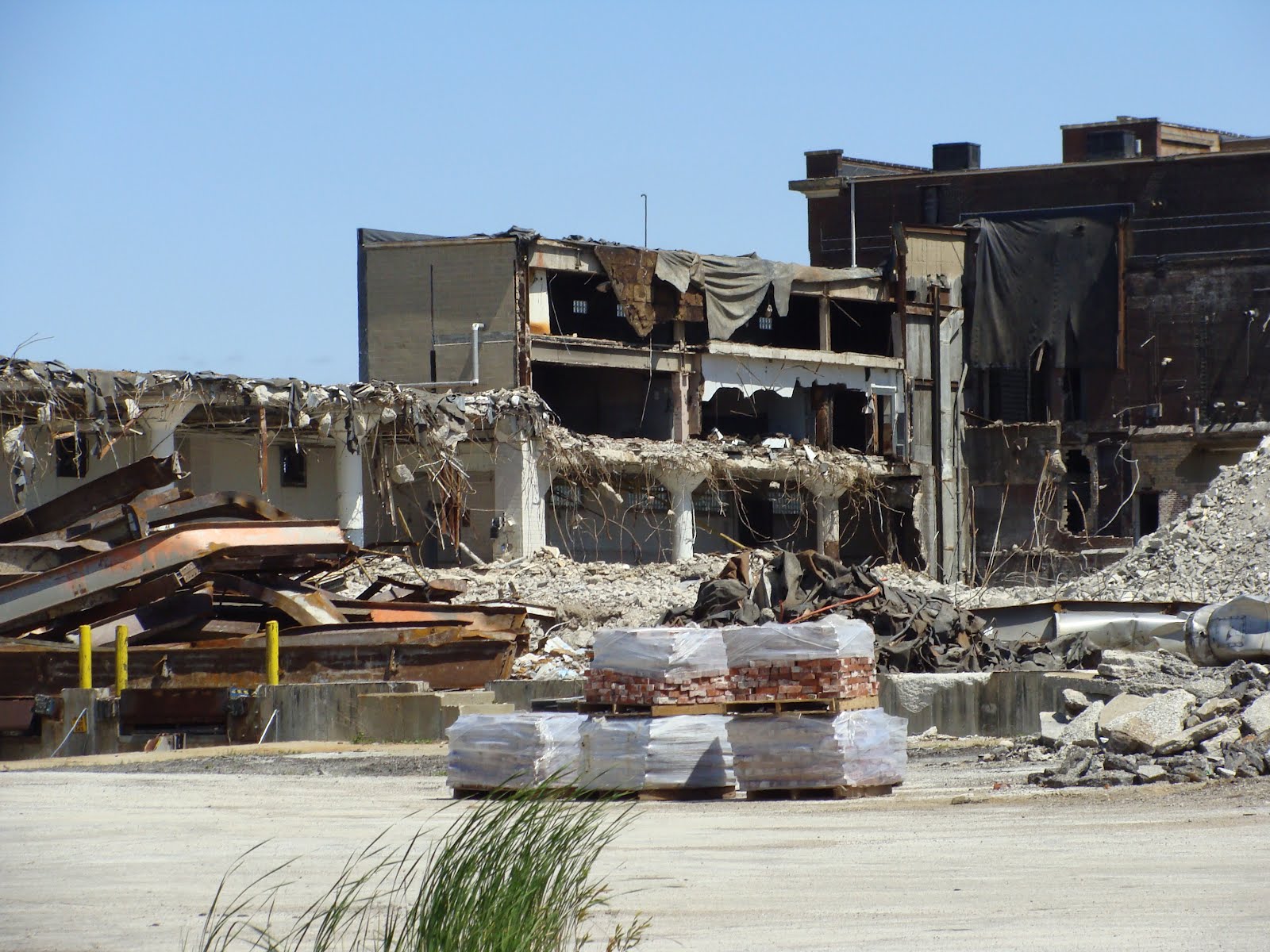
Pevely Dairy, Coming Down
The Pevely Dairy complex is being torn down, though you might not necessarily see it from Grand.In fact, the street facade is still perfectly preserved until SLU gets the necessary demolition permit, so perhaps there is still a chance they'll see the light.The office building isn't the perfect urban building, but replacing the glass block windows with better windows would go a long way to making it look much better.In the meantime, go enjoy the uniqueness of this structure, from the white bricks forming the Pevely name on the smokestack......to the little patches of green terracotta high up on the parapet of the office building.When the new Grand Bridge opens this year, commuters will not have to worry about any pesky buildings blocking sight lines at the corner, and can confidently fly around the corners with little worry of anything coming--certainly not pedestrians, other than the few unlucky souls who transfer buses at this most forlorn corner.
Friday, March 9, 2012
The Ville #2
The Ville and Greater Ville, which I've compressed into just simply The Ville, was once the center of the African-American middle class in St. Louis.I went back to the area last weekend to look around and check up on things; mostly nothing was different, though sadly many more buildings seem to have fallen vacant or worse since the time I visited two years ago.I find the housing stock outside of Grand Blvd to be an interesting counterpoint to the Second Empire and Italianate so prevalent east of that major street.I followed St. Louis Avenue, like last time, and I always get a kick out of the fact that the street is really a cobbling together of earlier streets of subdivisions that didn't match up.So there are all of these strange curves where traffic engineers attempted to smooth out the dog legs in the street.This burn-out is sadly too common of a feature in the area; while brick theft has come to The Ville, there obviously would be no motivation to burn a wooden house to harvest the bricks. Perhaps it was just a short circuit.I caught this view of the skyscrapers downtown as I proceeded past a break in the street wall. The conclusion if obvious: why isn't land so close to downtown more valuable?
Thursday, March 8, 2012
Wells-Goodfellow #2
I visited the Wells-Goodfellow neighborhood several years ago, focusing on St. Louis Avenue. I returned and while I tried to retrace my steps, I saw many new things.I know that for many people, the neighborhood represents everything that is wrong with St. Louis, and dismissively refer to it as the "ghetto," but I want to be more idealistic.Yes, it's disturbing to see just how badly this portion of the city has fallen, and much of the area looks semi-rural due to abandonment, which is what the neighborhood was for much of its history.What remains is just as beautiful of any area of the city west of Kingshighway, but just a little rough around the edges.I hope to get back soon and explore this varied and interesting area more.
Wednesday, February 29, 2012
1,500th Post: The Death of Central St. Louis
Continuing the tradition of my 1,000th post, I will again address a serious threat to the City of St. Louis
When was the last time you heard some say the following? "Hey guys, let's go take a stroll down Kingshighway in between Highway 40 and Interstate 44!"
Even if you replace "Kingshighway" with "Grand" or "Jefferson," I have a feeling the answer is still a categorical "Never."
Why is that? Why has a whole swath of the city become a no-man's land, devoid of houses, stores and really anything of value other than some rusty industrial buildings, most of which are empty? Was it always like this? Scanning over old property records and Sanborn maps, it's clear that the large Mill Creek railroad tracks have long occupied the area between Highway 40 and Interstate 44, so that could explain some of the malaise that occurs in this wide swath of land from Jefferson to Kingshighway. But the bookends, Dogtown and Lafayette Square, show that there was life in these areas, and indeed life still remains in those two vibrant neighborhoods.
I strongly believe the real culprits are the interstates which have sliced off the central portion of the city from the north and south sides. No one likes walking over an interstate, as planners realized in Washington, DC, luckily before the interstates could be completed in that city. Now, you can walk all the way from the Washington Monument to the District border in most directions and never have to confront the hell of an interstate on-ramp. In St. Louis, however, the central city neighborhoods were left isolated and targeted for "experimentation" on the part of city leaders who could use the different, admittedly suffering Compton Hill and McRee Town areas because they lacked strong advocates and neighboring areas to fight them.
Thankfully, the days of interstate building are over, but there's something just awful about the drive down what should be the major avenues of the city. It almost seems like the city's planners gave up on the area between the interstates, and started redesigning Kingshighway, Grand and Jefferson to get people in cars through the wasteland as fast as possible. We can do better, and the wastelands can hold new buildings again--or for the first time.
Let's work so that some day that Central St. Louis is the actual center of the city, and not the barren border lands between two vibrant halves.
Thursday, February 16, 2012
Still Hope for College Hill Neighborhood
I'm disappointed that College Hill has been removed from Preservation Review. The argument that the neighborhood is too far gone to save is the wrong attitude.If anything, the fact that so much has been lost warrants that what is left should be preserved that much more carefully.While admittedly several streets in the neighborhood have lost large amounts of housing stock, there are ample survivors on neighboring blocks that can help inspire the in-fill that could eventually fill the holes.I'm just really worried that when an entire neighborhood is swept away, we end up with bland, suburban-style housing that looks bad, is built cheaply, and ends up abandoned even faster than the original building stock.Take the example of the failed housing development in nearby Hyde Park; the last thing we need is "blank slate" development that always seems to fail.What remains in College Hill, which is substantial, should be likened to the remaining good teeth in a mouth; why on Earth would we want to pull more teeth when so many have already been lost? Do we want partial dentures, or pull all the healthy teeth out for an entire new set, and risk having no teeth at all?
Monday, February 13, 2012
The Near North Side West of Jefferson
North of Delmar, but west of Jefferson is a very important part of St. Louis's architectural history.Why? Because it represents an era of St. Louis history that was almost entirely demolished in the first half of the Twentieth Century, first by the commercialization of the central corridor of the city, and then by urban renewal that swept away large amounts of the oldest parts of the city.But just northwest of downtown, the relics of St. Louis's post-Civil Wat residential character cling to life, but only barely.Though devoid of major landmarks, and bypassed by major avenues to the north and south, this part of the city should be highly desirable due to its close proximity to to downtown and Grand Center.But it sits in isolation, blocked off streets preventing the natural movements of automobiles and mass transit through the area, with large swaths of vacant land permeating the area.I distinctly remember this area in the 1980's, when my family visited a church in the area. It was a maze of completely intact, though probably partly abandoned rows of houses, giving the sense of a real neighborhood.Just to the east is the former Pruitt-Igoe housing project site. Older housing stock, such as Second Empire and Italianate houses are now increasingly rare in the city, and are primarily found in neighborhoods like Benton Park or Soulard.Will help come to this neighborhood before the remnants are swept away and forgotten forever? Sadly, I have a bad feeling it will not.
Sunday, January 22, 2012
Fountain Park and Lewis Place North of Page
The area between Page Avenue and MLK Drive is a long suffering counterpoint to the better preserved areas to the south. This lone wood frame house is probably one of hte oldest houses on the block, built before the city came out this far.Here and there, a few houses are left, and they're owned by fiercely proud people, several of who I had the opportunity to talk to while I was in the area touring the tornado damage last year.Vacant lots, some with freshly planted grass, show that there has been substantial loss to the built environment. At what point does it become so degraded that everyone moves out? I've seen completely abandoned blocks further into the city.But the good news is that the majestic church down the block serves as a reminder of what had been, and what can be here again. Well maintained and occupied, it's the type of structure that can anchor the revived neighborhood.
Sunday, October 24, 2010
Saturday, October 23, 2010
Wednesday, November 4, 2009
Lake St. Louis, Central West End
Wednesday, September 2, 2009
Just Another Dead Block in Grand Center
Subscribe to:
Posts (Atom)
A Blog detailing the beauty of St. Louis architecture and the buildup of residue-or character-that accumulates over the course of time.